Newark doesn’t always make the list when people talk about the East Bay, but the healthcare professionals who work here know exactly where they stand. Tucked along the southern Alameda County shoreline between Fremont to the south and Union City to the north, Newark is a compact, working community of roughly 50,000 residents whose clinical workforce punches well above its population weight. Nurses, emergency technicians, and allied health professionals based in neighborhoods like Cherry-Guardino, NewPark, and the Willow Street corridor commute daily to some of the Bay Area’s most active medical facilities — and every one of them carries an AHA renewal requirement that doesn’t pause between shifts, family obligations, or the traffic-choked stretches of the Dumbarton Bridge corridor that define daily life in this part of Alameda County.
The case for staying current on BLS, ACLS, and PALS training isn’t abstract in a community like Newark. According to the American Heart Association, immediate CPR can double or triple survival rates in cardiac arrest — a fact that takes on tangible meaning in a city where residential neighborhoods sit alongside industrial corridors and a diverse, multigenerational population that relies heavily on the regional healthcare network surrounding it. Clinical professionals serving Washington Hospital Healthcare System in Fremont, St. Rose Hospital in Hayward, and the broader network of Alameda County medical facilities are the first line of response to cardiac emergencies across this stretch of the East Bay shoreline. Their preparedness isn’t incidental — it’s structural.
What many of those professionals are now weighing more carefully is not simply whether to fulfill their BLS, ACLS, or PALS requirement, but which format makes that process actually achievable given the realities of their working lives. Two distinct options exist: traditional instructor-led classroom training and the increasingly preferred Self-Guided Learning™ model paired with CPR Verification Station™ learning centers. Both lead to successfully completing the course and receiving an AHA Course Completion eCard. This guide compares both honestly and directly, so Newark’s healthcare workforce can make the choice that fits their professional reality.
Overview of CPR Training Options in Newark
For healthcare professionals throughout Newark and neighboring Alameda County communities like Fremont, Union City, and Hayward, two primary formats are available for completing BLS, ACLS, and PALS requirements:
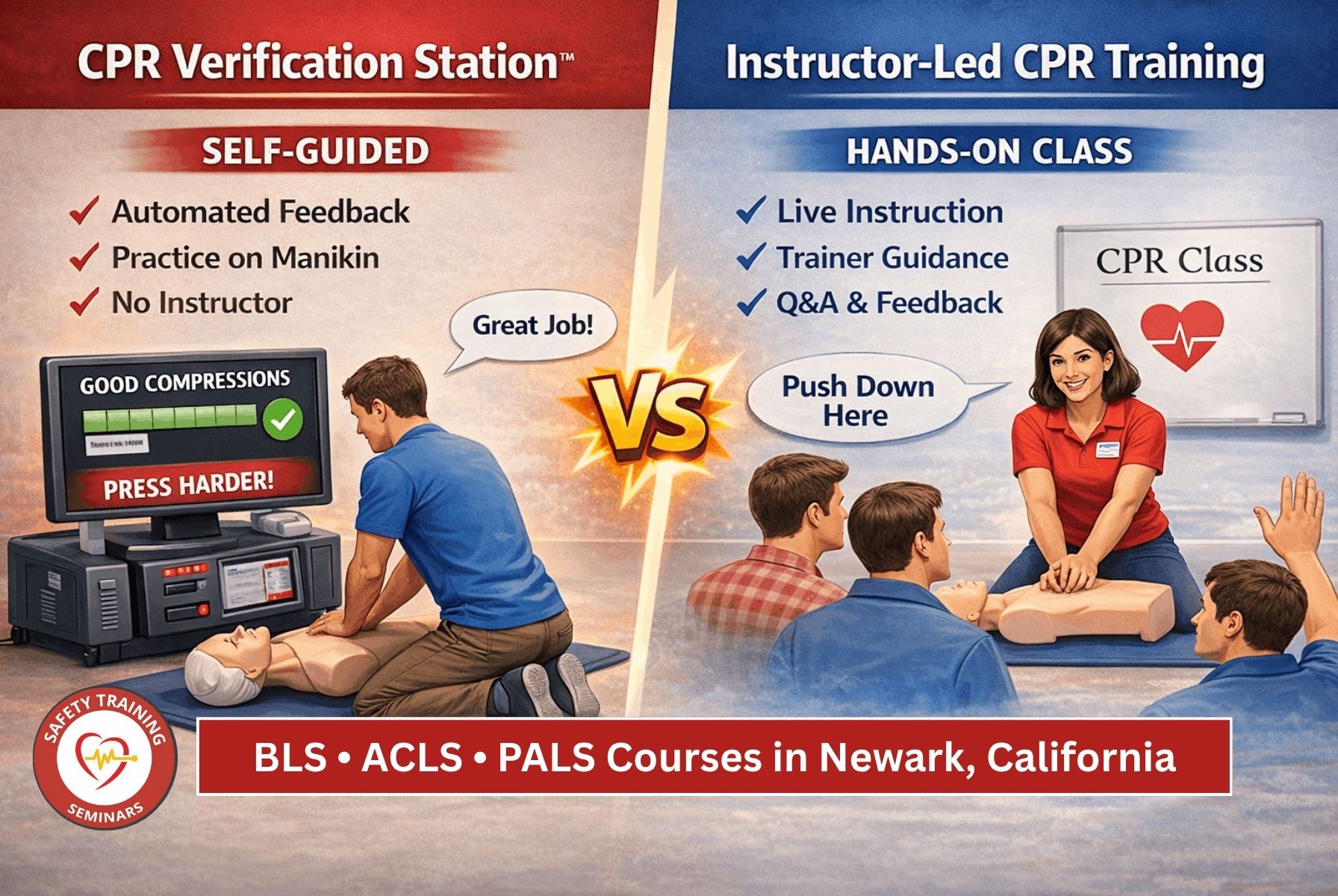
- Instructor-Led Training — A fixed-schedule, in-person classroom session facilitated by a course instructor, where both cognitive content and hands-on skills practice are delivered in a single multi-hour block, typically running four to eight hours depending on the program.
- Self-Guided Learning™ + CPR Verification Stations — A flexible two-part model in which learners complete an adaptive online course on their own schedule, then attend a brief, technology-evaluated skills session at a CPR Verification Station™ learning center.
Both pathways result in an AHA Course Completion eCard upon successfully completing the course. The practical experience of reaching that outcome, however, differs meaningfully — in ways that matter particularly to a workforce as schedule-intensive and geographically dispersed as Newark’s clinical community.
Traditional Instructor-Led CPR Training in Newark
Instructor-led training has been the standard format for AHA BLS, ACLS, and PALS programs throughout Alameda County for decades, and it remains a recognized option for healthcare teams across the Newark and Fremont corridor. In this format, participants arrive at a scheduled training facility, join a group of fellow learners, and work through AHA-approved curriculum content under the direct guidance of a course instructor. The session moves from video instruction and live technique demonstration through hands-on skill stations covering chest compressions, airway management, defibrillation, and increasingly complex scenario-based resuscitation protocols as the program level rises from BLS to ACLS to PALS.
For clinical departments at Washington Hospital Healthcare System in Fremont — the primary acute care facility serving the immediate Newark area — employer-coordinated group sessions in this format have historically provided a workable structure when institutional logistics manage the scheduling. Healthcare workers commuting from Newark to facilities in Hayward, Milpitas, or further into the South Bay have also accessed classroom-based programs in this format when employer arrangements make it feasible. The friction appears when individual professionals must independently navigate the process of finding and attending a session that actually fits their availability.
How Instructor-Led Training Works
A standard BLS class in Newark’s instructor-led format typically runs between two and a half and four hours. ACLS courses extend significantly — often to six or eight hours — given the depth of material involved: advanced cardiac rhythm interpretation, pharmacology protocols, complex airway management techniques, and multi-role team resuscitation scenarios requiring extended hands-on practice. PALS programs follow a comparable timeline through a pediatric lens, with age-specific assessment frameworks and intervention protocols that require sustained, deliberate attention at every stage.
Throughout the session, the trainer observes participant technique at each skill station, provides real-time verbal coaching, and confirms that AHA performance criteria have been met before signing off. When all components are cleared, learners successfully complete the course and receive their AHA Course Completion eCard. For participants encountering ACLS or PALS content for the first time, the live trainer presence can provide a level of immediate guidance and contextual explanation that independent study alone sometimes cannot replicate.
Limitations of Instructor-Led Classes
Newark’s position at the intersection of I-880, the Dumbarton Bridge approach, and the dense traffic of the Fremont border zone creates a commuting environment that already tests the patience of most clinical professionals on any given workday. Adding a full-day classroom commitment on top of a rotating shift schedule — often requiring travel to a training site in Hayward or Fremont or even San Jose — translates into a time cost that is genuinely burdensome. For a nurse in the Cherry-Guardino neighborhood finishing an overnight shift, arriving alert and focused at a training facility by 8 a.m. for a six-hour ACLS program isn’t just inconvenient. It’s cognitively unrealistic.
Scheduling scarcity adds a separate and often underappreciated dimension of difficulty. Popular ACLS and PALS sessions near major Alameda County medical centers book out weeks in advance during high-demand renewal periods. A healthcare professional from Newark’s NewPark area whose compliance deadline is approaching may discover that every available classroom session within a practical driving range is already full — leaving waitlisting as the only option in a situation where professional compliance deadlines don’t bend to accommodate backlogs. For shift workers managing rotating 12-hour patterns, the prospect of clearing a fixed full day from a schedule that changes week to week often moves quickly from inconvenient to simply not possible.
The Rise of CPR Verification Stations in Newark
Across southern Alameda County, the misalignment between the traditional classroom model and the actual scheduling realities of a modern clinical workforce has steadily driven adoption of more flexible, technology-supported training solutions. CPR Verification Stations represent one of the most meaningful advances in that evolution — replacing the group-paced, observer-dependent skills evaluation of the conventional classroom with a learner-controlled, objectively measured verification process designed for how today’s healthcare professionals actually operate.
Training providers serving the Newark and East Bay region have observed firsthand how scheduling inflexibility in the traditional model creates compliance delays and professional frustration — and have responded by incorporating CPR Verification Station-based evaluation as a core component of their program offerings. For a community like Newark, where clinical professionals manage demanding schedules against a backdrop of Bay Area traffic and multi-facility commuting patterns, that response reflects an accurate understanding of what the local workforce genuinely needs.
What Is a CPR Verification Station?
A CPR Verification Station™ learning center is a precision technology system built around sensor-equipped manikins that capture real-time, granular data on every element of CPR performance. Compression depth, rate, hand placement accuracy, full chest recoil between compressions, and the timing and volume of each ventilation are measured continuously and assessed automatically against current AHA performance standards. The result is immediate, objective feedback that doesn’t vary based on who is observing, how many participants are in the session, or any external factor outside the learner’s own demonstrated technique.
For Newark’s clinical professionals — many of whom work in environments where performance is measured against consistent, documented standards — a skills evaluation system operating on those same principles of objective measurement carries natural professional credibility. The sensors capture what they capture. The AHA standard is applied uniformly. Every time.
How Self-Guided BLS, ACLS, and PALS Courses Work
The online knowledge component of the Self-Guided Learning™ model is delivered through the HeartCode® Complete course — the AHA’s approved digital curriculum for BLS, ACLS, and PALS programs. What distinguishes HeartCode® from a conventional online video module is the responsive intelligence at its core: True Adaptive™ learning powered by Area9 Lyceum.
This platform continuously monitors how each participant engages with course content and adjusts the learning experience in real time based on demonstrated understanding. An experienced ER nurse from Newark’s Willow Street area renewing her ACLS program doesn’t sit through foundational rhythm content she has applied clinically for the past five years — True Adaptive™ learning powered by Area9 Lyceum identifies her existing fluency with that material and advances to the content where genuine review and reinforcement add value. For a newer EMT working through the BLS program, the platform responds entirely differently — slowing down at challenging concepts, revisiting material where gaps are detected, and confirming comprehension at each stage before advancing. The result is a learning experience that is genuinely personalized rather than uniformly paced.
Once HeartCode® Complete is finished, the participant schedules a focused skills session at a nearby CPR Verification Station™ location. The hands-on evaluation is brief, targeted, and produces an objective performance record against AHA standards. The AHA Course Completion eCard follows.
Key Advantages of CPR Verification Stations
For healthcare professionals across Newark and neighboring communities including Fremont, Union City, and Hayward, the practical advantages of this model are direct, concrete, and immediately relevant to working clinical life:
- Unrestricted scheduling — The HeartCode® Complete online course can be started, paused, and completed at any time — late evenings after shifts, early mornings before them, or distributed across multiple sessions over a week or more.
- Genuine time efficiency — True Adaptive™ learning powered by Area9 Lyceum removes redundant review for experienced clinicians, meaningfully reducing total course time compared to the uniform, group-paced structure of a traditional full-day classroom session.
- Objective, consistent evaluation — CPR Verification Station™ technology applies standardized AHA performance criteria uniformly, eliminating the natural variability that comes with human observation across different instructors and session conditions.
- Locally accessible — Shorter, more flexibly bookable skills sessions fit a Newark professional’s actual weekly calendar far more naturally than a blocked full-day classroom commitment across a congested Bay Area commute.
Why Healthcare Professionals in Newark Prefer Self-Guided Learning
The residents of Cherry-Guardino, the professionals living near the NewPark Mall corridor, and the clinical workers housed throughout Newark’s quieter residential streets all share a common reality: their schedules are demanding, their commutes are real, and the idea of surrendering a full day to a fixed classroom program when a more efficient option exists is increasingly hard to justify.
Self-Guided Learning™ courses offer a concrete resolution to that tension. A medical assistant rotating between a Newark outpatient clinic and a Fremont hospital system can complete the BLS program online across several evenings at home, then book a focused skills session at a nearby CPR Verification Station™ location when her week allows — not when a training center happens to have an available slot. A respiratory therapist commuting between Newark and Washington Hospital Healthcare System can work through the ACLS course during off-hours over the course of two weeks, handling the cognitive component on his own time and completing the hands-on evaluation at a moment that fits his actual schedule. That practical flexibility represents a direct and meaningful upgrade in how accessible high-quality AHA training is for this community.
Instructor-Led vs. CPR Verification Stations: Side-by-Side Comparison
Examined side by side, these two formats reflect fundamentally different assumptions about who the training process is designed to serve. Instructor-led programs are built around the delivery event — a fixed date, a fixed location, and a uniform pace that applies to everyone in the room regardless of their clinical background, experience level, or scheduling constraints. That structure can work well for certain learners in certain circumstances. For most working healthcare professionals in a community like Newark — managing Bay Area commutes, rotating shifts, and per diem arrangements across multiple facilities — it creates more obstacles than it removes.
Self-Guided Learning™ with CPR Verification Stations is built entirely around the individual learner. HeartCode® Complete responds to demonstrated knowledge through True Adaptive™ intelligence, directing time and attention only where genuine learning value exists. The CPR Verification Station™ skills component is brief, locally bookable, and evaluated by technology that applies the same consistent AHA standard regardless of session timing or external conditions. On flexibility, time efficiency, scheduling control, and evaluation consistency, the Self-Guided Learning™ model holds a decisive practical advantage — and those are precisely the dimensions that determine whether a Newark healthcare professional can actually complete their renewal before the compliance deadline arrives.
Which Option Is Better for You in Newark?
Instructor-led training is the right fit if you’re completing an ACLS or PALS program for the very first time and benefit from the structure of a live, trainer-guided group environment. Some participants — particularly those working through multi-role resuscitation scenarios or pediatric emergency protocols for the first time — find that a course instructor physically present to demonstrate technique and answer questions builds foundational confidence that’s harder to develop independently. If the material is genuinely new and your schedule can accommodate a full-day commitment, the classroom format offers real educational value.
Self-Guided Learning™ is the stronger choice if you’re renewing familiar coursework, your schedule shifts unpredictably, or you simply need an efficient path to completing your BLS class in Newark, finishing your ACLS program before a deadline, or wrapping up your PALS course without giving up a full day off. For experienced clinical professionals managing the demands of Alameda County’s southern healthcare corridor, this is the format designed for how they actually work and live.
Local Demand for CPR BLS, ACLS, and PALS Training in Newark
The clinical renewal pipeline in and around Newark draws from a broad and active network of Alameda County healthcare facilities. Washington Hospital Healthcare System in Fremont is the primary acute care facility for the immediate Newark area and maintains ongoing BLS, ACLS, and PALS compliance requirements across its clinical teams. Professionals regularly travel to St. Rose Hospital in Hayward, Eden Medical Center in Castro Valley, ValleyCare Medical Center in Pleasanton, and Stanford Health Care facilities further into the South Bay — each maintaining their own active renewal schedules for AHA-trained staff.
The Newark Fire Department contributes its own contingent of emergency responders to the local AHA training renewal pool. With two-year renewal cycles running continuously across all of these organizations and an Alameda County population that continues to grow in healthcare complexity and demand, the need for accessible CPR training near Newark is consistent and substantial throughout the year. The steady shift toward flexible, technology-supported training formats reflects a workforce that has clearly outgrown the scheduling assumptions of the traditional classroom model.
How Safety Training Seminars Supports Modern CPR Training
Safety Training Seminars serves healthcare professionals across Newark, Fremont, Union City, Hayward, and the broader southern Alameda County region by offering both instructor-led options and the Self-Guided Learning™ model backed by CPR Verification Station™ learning centers — ensuring every participant has a pathway that genuinely aligns with their schedule, experience level, and professional requirements.
The full program portfolio includes BLS, ACLS, PALS, NRP, and First Aid, covering the complete range of AHA training needs across clinical and non-clinical roles. The combination of quality curriculum, genuine scheduling flexibility, and accessible local skills verification has made Safety Training Seminars a trusted resource for healthcare teams across the East Bay — one that understands the real demands facing Newark’s working clinical professionals and has built its offerings around what those professionals actually need.
The Future of CPR Training in Newark
The direction of healthcare training is consistent and accelerating across the industry. Personalized, technology-integrated learning experiences built around the individual learner are progressively replacing the one-size-fits-all classroom model as the standard for clinical training delivery. True Adaptive™ learning powered by Area9 Lyceum and CPR Verification Stations represent the forefront of that transformation, and the healthcare organizations in Alameda County that have already embraced these tools are seeing measurable improvements in compliance rates, training efficiency, and overall learner engagement.
For Newark’s healthcare professionals, this isn’t a trend arriving from somewhere else. It’s a practical, available option today — already reshaping how the community’s most forward-thinking clinicians approach their AHA renewal requirements.
Start Your BLS, ACLS, or PALS Course in Newark Today
Whether you’re pursuing a BLS course in Newark for the first time or renewing your ACLS program before a compliance window closes, a training pathway designed for your schedule and your professional life is available right now. Healthcare professionals throughout Alameda County — from Cherry-Guardino to NewPark, from Fremont to Union City — are already completing their programs through the Self-Guided Learning™ model, receiving their AHA Course Completion eCard, and returning to their clinical roles without the disruption and delay of a mandatory full-day classroom commitment.
Don’t let a booked-out session or a Dumbarton corridor traffic jam push your renewal into non-compliance. Choose the format that fits your life, complete your BLS, ACLS, or PALS training in Newark on your own terms, and stay current with the skills your patients depend on.