Warehouse and distribution-center employees in Newark, CA, usually do not need the same CPR credential as nurses, EMTs, or other clinical professionals. For most nonmedical workplace teams, the more appropriate starting point is First Aid, CPR, and AED training. A BLS CPR Certification Course is generally more appropriate when an employer specifically requires BLS or when the employee works in healthcare, emergency response, or a healthcare training program.
“CPR certification” is not one universal course. A forklift operator, shift supervisor, on-site medical professional, and nursing student may have different requirements. The best choice is the course that matches the employee’s duties and the employer’s written safety policy.
Key Takeaway: Most warehouse employees should first check whether their employer requires workplace First Aid/CPR/AED training or specifically requires BLS. BLS is designed mainly for healthcare professionals and trained first responders, while workplace CPR and first aid courses are typically intended for people with little or no medical training.
Start With the Employee’s Role, Not the Course Name
The quickest way to choose the right class is to identify what the employee is expected to do during an emergency.
For a typical warehouse associate, picker, packer, forklift operator, shipping employee, inventory worker, or supervisor, First Aid/CPR/AED training is usually more directly aligned with workplace response needs. The American Heart Association describes its workforce-focused Heartsaver courses as intended for people with little or no medical training who need first aid and CPR training for job or regulatory requirements.
BLS is different. The American Heart Association’s BLS Provider Course is designed for healthcare professionals, trained first responders, and people enrolled in healthcare training programs.
If a Newark employer simply says “CPR and first aid certification,” employees should not automatically register for BLS. Ask for the exact course or completion card the company requires.
When a BLS CPR Certification Course Makes Sense
BLS can still be the correct choice for someone who works in or around a warehouse. The deciding factor is the person’s professional role rather than the building where they work.
BLS may be appropriate for:
- Nurses, EMTs, paramedics, or other healthcare professionals working on-site
- Trained first responders whose employer specifically requires BLS
- Healthcare or nursing students who need BLS for a clinical program
- Employees whose job description or company policy explicitly names BLS
- People renewing a BLS credential required for professional duties
BLS covers high-quality CPR, AED use, ventilation, recognition of life-threatening emergencies, and coordinated response. Employees who have been told they need BLS should confirm the exact requirement with their employer or school before registering.
Why First Aid Matters in a Warehouse Setting
Warehouse emergency planning goes beyond cardiac arrest. Workers may experience cuts, falls, strains, impact injuries, or equipment-related incidents that call for immediate first aid while professional medical help is being contacted.
OSHA’s warehousing guidance points employers to medical-services and first-aid requirements and states that a trained first-aid provider should be on-site unless sufficiently prompt outside medical services are available.
California Title 8, Section 3400 also requires employers to provide ready access to medical advice and, when an infirmary, clinic, or hospital is not in near proximity and used for injured employees, to have one or more people adequately trained to render first aid.
That does not mean every Newark warehouse worker needs the same CPR card. The employer should determine the workplace’s first-aid needs, and employees should take the course that matches that plan.
CPR, AED, First Aid, or BLS: A Simple Way to Choose
- CPR/AED training: For employees expected to recognize cardiac arrest, perform CPR, and use an AED.
- First Aid plus CPR/AED: For workplace responders who may need to handle both cardiac and non-cardiac emergencies.
- BLS: For healthcare professionals, trained first responders, healthcare students, or employees whose organization specifically requires Basic Life Support.
- ACLS, PALS, or NRP: Generally for specific clinical roles, not standard warehouse safety duties.
If the requirement is unclear, ask the employer for the exact course name and the type of completion card they will accept. This is especially useful for temporary staff, contractors, or students who may be meeting requirements from more than one organization.
Planning Training for Newark and Nearby East Bay Employees
Newark employers may have staff commuting from Union City, San Leandro, Castro Valley, San Lorenzo, Oakland, Pleasanton, or Piedmont. For workers assigned to training near home rather than the jobsite, comparing a CPR and BLS course location in Oakland or training options in Pleasanton may be useful.
The course requirement should come first, however. Supervisors arranging training for multiple shifts should identify which employees are designated first-aid responders, which workers need general workplace training, and whether any staff members have healthcare roles that call for BLS.
Reviewing Training Options in Newark
Safety Training Seminars provides local course information for people comparing CPR, First Aid, and BLS training in Newark. The local training center is listed at 8407 Central Ave, Suite 2034, Newark, CA 94560.
Before enrolling, warehouse employees should compare the employer’s requirement with the course type shown on the Newark location page. Employees based elsewhere in the East Bay can also review the San Leandro CPR and BLS course page.
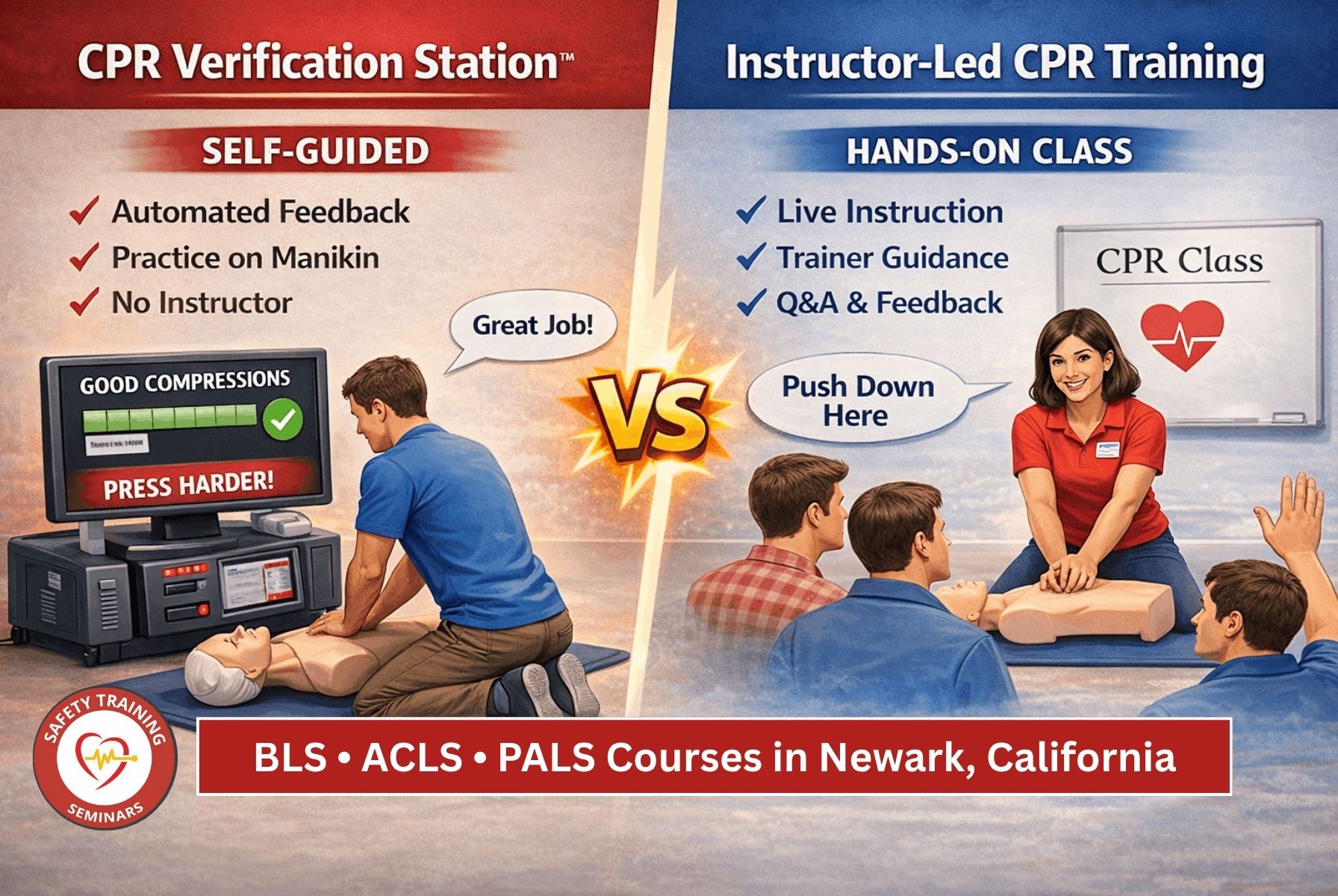
Course format matters too. The American Heart Association notes that blended CPR pathways pair online learning with hands-on skills practice, so employees should verify whether their required credential includes an in-person or hands-on component rather than assuming online-only training will be accepted.
What Should an Employee Confirm Before Registering?
A short check with a supervisor, HR representative, safety manager, school, or licensing body can prevent registering for the wrong course.
Ask:
- What is the exact course name required?
- Is First Aid required in addition to CPR and AED training?
- Does the employer specifically require BLS?
- Is a hands-on skills assessment required?
- Is the training for a workplace safety role, a healthcare role, or both?
- If renewing, is a particular renewal credential required?
Do not rely only on a coworker saying, “You need CPR.” Two employees at the same distribution center can legitimately need different training.
Frequently Asked Questions
Do all warehouse employees in Newark need BLS certification?
No. BLS is mainly designed for healthcare professionals, trained first responders, and healthcare students. A general warehouse employee may instead need workplace First Aid/CPR/AED training. The exact requirement depends on job duties and the employer’s safety program, so confirm the required course before enrolling.
Should a warehouse safety lead take First Aid and CPR together?
Often, that combination makes practical sense because a safety lead may respond to injuries as well as cardiac emergencies. However, the employer should specify the required training. California workplace rules address first-aid readiness but do not make one identical CPR course mandatory for every employee in every warehouse.
Can Union City or Oakland employees take their required course in Newark?
Generally, yes, provided the course satisfies the employer’s or organization’s requirement. Employees coming from Union City, Oakland, or another nearby community should confirm the course type first, then choose a training location that works for their schedule and travel needs.
Is online-only CPR training enough for a warehouse job?
Not always. Acceptance depends on the employer and the credential required. Some CPR training pathways use online learning followed by a separate hands-on skills session. If demonstrated CPR or AED skills are required, verify the completion requirements before choosing an online option.
Does a warehouse employee ever need ACLS, PALS, or NRP?
Usually not for a standard warehouse position. Those courses are associated with specific healthcare and clinical responsibilities. An employee should take one only when a healthcare employer, clinical program, licensing body, or another responsible organization specifically requires it.
Choose the Course That Matches the Job Requirement
For warehouse and distribution-center employees in Newark, CA, the right CPR course starts with the job requirement. Most nonmedical workers should first determine whether they need First Aid/CPR/AED training, while BLS is more likely to apply to healthcare professionals, trained first responders, healthcare students, or employees whose company specifically requires it.
Safety Training Seminars provides local course information for Newark and nearby East Bay communities, but employees should confirm the exact credential before registering. This helps avoid choosing a course that does not match the actual workplace requirement. Reviewing the Newark CPR, First Aid, and BLS course information is a practical next step for comparing course types, location details, and registration information against the requirement supplied by an employer, school, or professional organization.